new-solar-sunset.jpg?w=1024&h=702&scale

Project Information

Why are we developing the solar project?

  • Fife Council has declared a Climate Emergency and the Scottish Government has set a target date of 2045 for reaching net-zero emissions.  The Climate Change Act 2019 means that Scotland has some of the most stringent statutory targets in the world.
  • The importance of taking action to address the Climate Emergency is recognised at a local, national and international level.  Projects such as Dunfermline Solar will help in achieving these targets.
  • Dunfermline has good levels of solar irradiance; it has brownfield land that can be transformed; and it has power-users and new urban/residential development in need of green electricity.

Will solar power generation work in Fife?

  • Solar panels need daylight, not sunshine or high temperatures, so solar panels can and do work well in Scotland – especially in the summer months and the long daylight hours in Scotland.
  • Solar can help balance the grid with wind farms being more productive in the winter months when Scotland has higher than average wind speeds.

What does the project consist of?

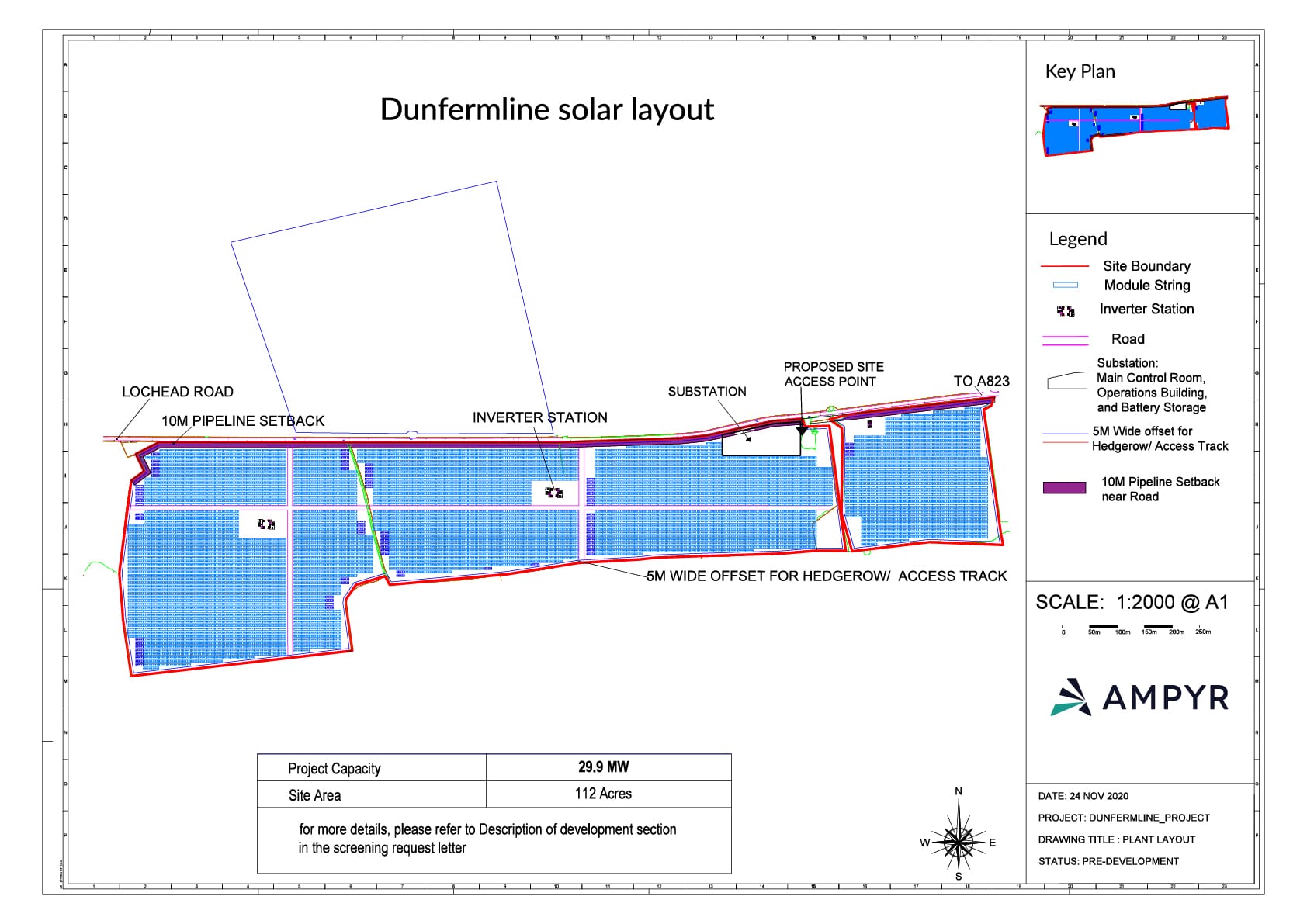
  • The plan takes in about 112 acres of land that was formerly an open cast coal mine.
  • The project will consist of around 82,500 panels, with a power generation capacity of around 29MW AC and associated battery storage in order to store & supply power when the sun doesn’t shine (current proposals are for 20 batteries, each the size of a shipping container)
  • The panels will be set on lightweight frames and will reach around 3.0 m above the ground
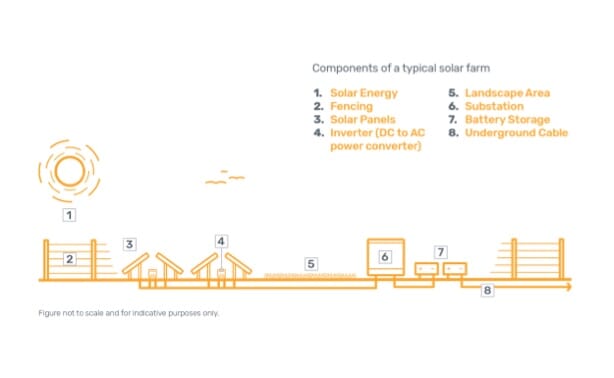
  • The power will be transmitted via 6 power inverters to convert DC current into AC and a transformer and would connect to the grid at the Townhill Substation. An offer to connect to the grid has been obtained from Scottish Power Energy Networks. There may also be opportunities for large local power-users to connect directly by “private wire”
  • The area under the panels can safely be used for grazing since the panels will be 0.5m above the ground.

How does it work?

  • Solar panels are made out of photovoltaic cells (which is why generating electricity with solar panels is also called solar PV) that convert the sun’s energy into electricity.
  • Photovoltaic cells are sandwiched between layers of semi-conducting materials such as silicone. Each layer has different electronic properties that energise when hit by photons from sunlight, creating an electric field. This is known as the photoelectric effect – and it’s this that creates the current needed to produce electricity.
  • Solar panels generate a direct current of electricity. This is then passed through an inverter to convert it into an alternating current, which can then be fed into the National Grid or directly to large local power users.

How long will the project take to develop?

Once the consultation process has taken place, we will take on board the feedback in relation to the proposals. Our aim is to submit a planning application for consideration by Fife Council by Summer 2021. If it gains their support then we aim to have the project operational and supplying power to the community within 18 to 24 months.

The transformation of the site has the potential to help towards all of Fife Council’s energy objectives :

  • Climate friendly, transforming the economy, infrastructure, land use and energy system to decarbonise how we live;
  • Climate ready, increase the resilience of Fife communities and the economy to help minimise the impacts from unavoidable climate change; and
  • Climate just, ensuring that all Fifers and the Fife environment can benefit from this transition.
assemble-solar-panels.jpg?w=813&h=1024&scale

Why do we need the project?

The UK is transitioning to zero and low carbon sources of power. All coal fired power stations have to close by 2025 meaning over a quarter of the UK’s energy generation needs to be replaced. The UK’s climate change ambitions are amongst the highest in Europe and the aim to achieve net-zero carbon emissions by 2050 is set in law.

By 2050 we could also use 80% more electricity than we do today. For example, the growth in electric vehicle ownership has grown thirty-fold and is set to rise with the abolition of new diesel and petrol cars by 2040.

Currently the UK’s electricity price is the among the highest in Europe, meaning that we need to find ways of generating more affordable, renewable and clean electricity such as that generated by Dunfermline Solar Park.

How will local wildlife and habitat benefit?

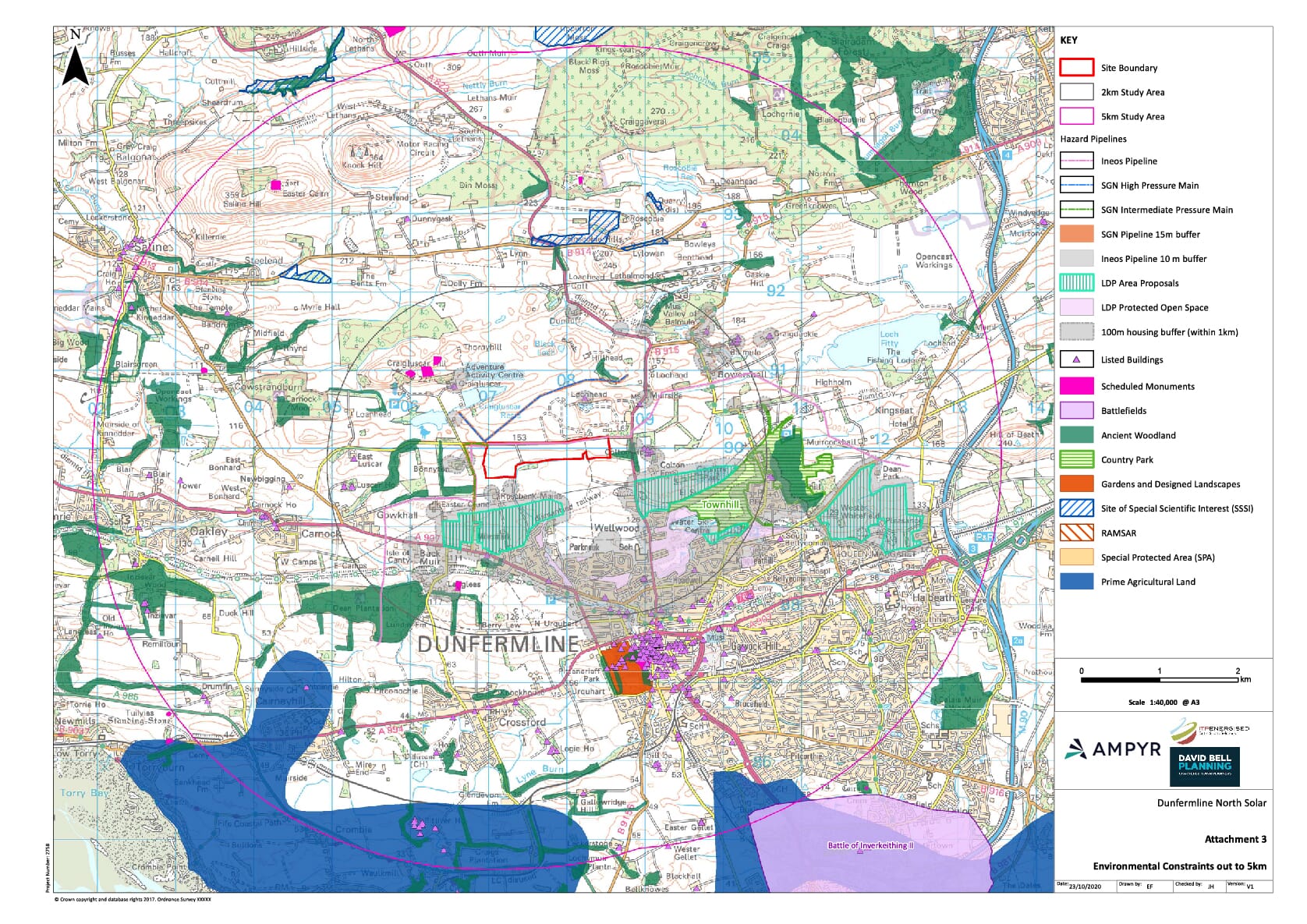
An active habitat management plan is being drawn up for the site and we intend working with local wildlife and ecology groups on the plan. It will consider aspects of bio-diversity in the planting and management of the green area around and under the panels.

Ornithologists are currently undertaking detailed bird surveys to determine which species of birds are present or migrate through the site.

How will the local area benefit?

Aside from helping Dunfermline move to a zero carbon future, the project will represent a significant investment in the local economy. Pennon Group is establishing a skills, supply chain and employment plan and aims to utilise local suppliers for equipment and services wherever possible.  If interested, please do contact us.

new-local-area.png?w=1024&h=703&scale